
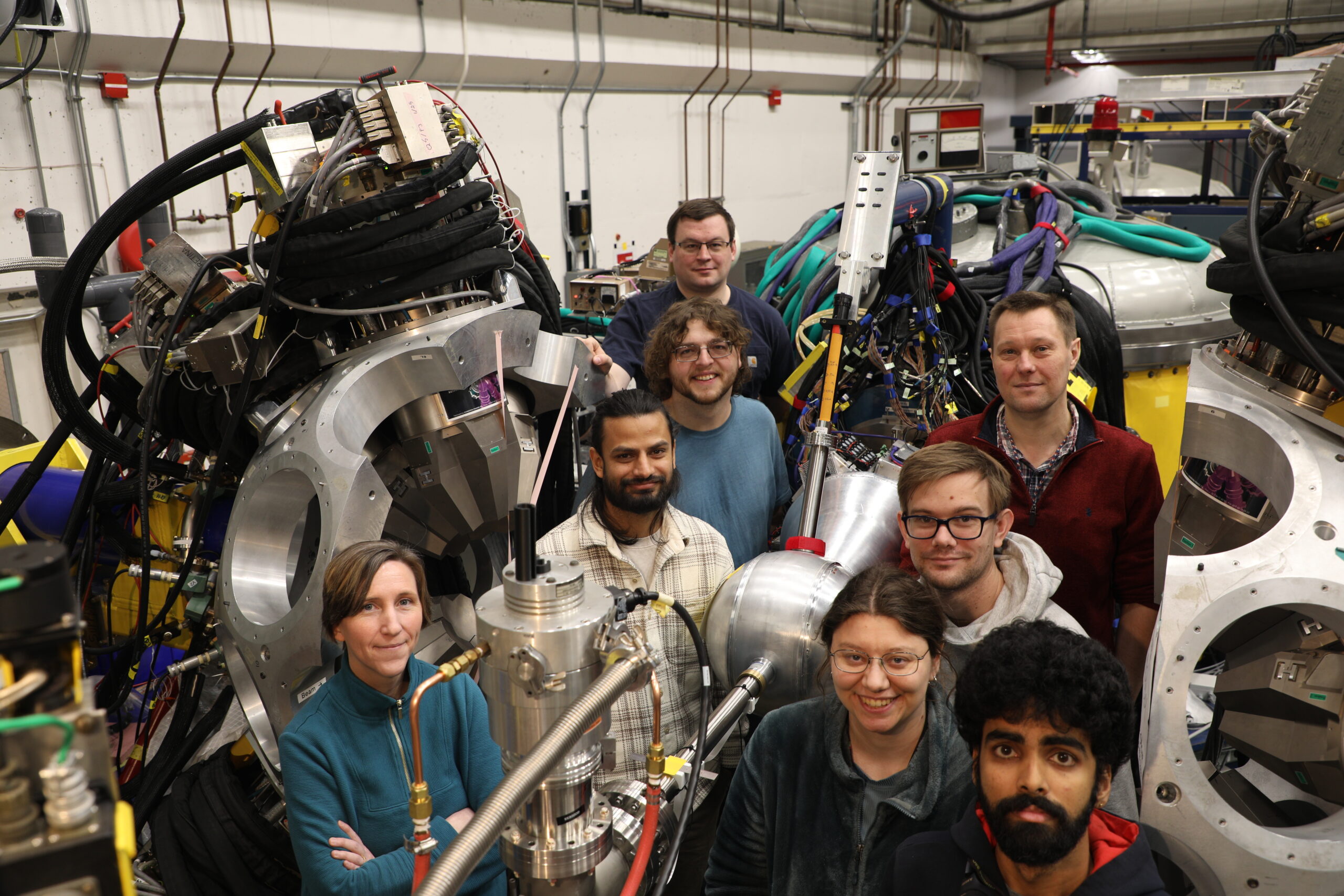
GODDESS has successfully completed its 2025 campaign at the ATLAS facility at Argonne National Laboratory. Over the course of roughly four months (Feb-May), the GODDESS collaboration performed six Program Advisory Committee approved experiments, touching on subjects from nuclear astrophysics to stockpile stewardship.
ATLAS, the premier DOE-NP User Facility for stable isotope beams, developed and delivered several new beams specifically for the GODDESS campaign, including the highest-ever energy proton beam from ATLAS, and the first-ever ATLAS-accelerated deuteron beam. The GODDESS campaign totaled 37 days (almost 900 hours) of beam on target, plus multiple weeks for the initial system setup, calibrations, detector reconfiguration between experiments, and teardown.
The campaign supported more than 50 researchers, spanning from undergraduates to senior staff and emeritus faculty, from a dozen national and international institutions.
This GODDESS campaign featured:
- an experiment proposed and led by Matt Christie, an SCGSR student working with Steve Pain (ORNL), to study the astrophysically-important Hoyle state in 12C
- an experiment led by Notre Dame graduate student Scott Carmichael to study astrophysically-important states for 34Cl(p, γ) in novae
- an experiment led by LLNL postdoctoral researcher Rajesh Ghimire to constrain astrophysically-important neutron-induced reactions on the 56Ni using the Surrogate Reaction Method
- three experiments led by LLNL scientist Andrew Ratkiewicz, to constrain neutron-induced reactions on the astrophysically-important 64Zn (for the νp process), constrain reactions important for applications, and to benchmark the Surrogate Reaction Method for reactions on deformed nuclides.


