
GODDESS system has two Letters accepted in one month (June 2026), reporting on the open quantum system Carbon-14 and radioisotope Titanium-44 production in supernova explosions.
High-efficiency, precision particle-γ coincidence experiments with GODDESS at ATLAS enabled isolation of weak transitions from near-threshold states from large reaction backgrounds, along with enhanced precision in energy and lifetime from event-by-event Doppler corrections from high-resolution proton detection.
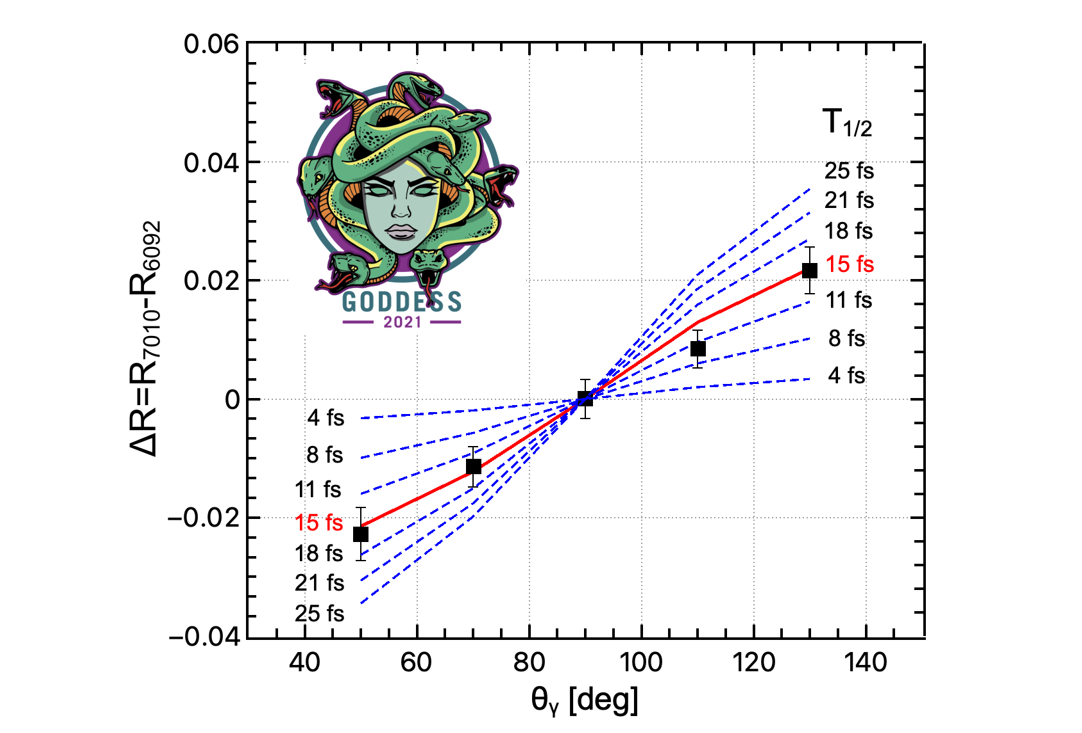
In one experiment, graduate student Giacomo Corbari (under the supervision of Silvia Leoni, University of Milano) studied the open quantum system 14C, via the 9Be(6Li,pγ)14C reaction, to understand the role of the continuum on weakly-bound excited states that cannot be understood by standard Shell-Model calculations. This experiment used the selectivity and high-resolution position measurement of the ORRUBA charged-particle detection to provide precise constraints on lifetimes of weak near-threshold states. The results can be understood by the role of continuum coupling, and provide constraints on the continuum coupling constant in the cutting edge Shell Model Embedded in the Continuum.
See:
“Impact of the continuum on the γ decay of the lowest 2+ states in 14C” , G. Corbari, Phys. Lett. B 879 (2026) 140630

Secondly, Scott Carmichael undertook the first experimental determination of the 57Ni(p, γ)58Cu rate from via 58Ni(3He, t)58Cu from precision γ-ray spectroscopy from a GODDESS experiment at ATLAS, results of which were combined with charged-particle spectroscopy using the newly refurbished Enge Spectrograph at the Nuclear Science Laboratory at the University of Notre Dame. The levels determined from these experiments with high-precision in energy enable the first experimental constraints on the astrophysical 57Ni(p, γ)58Cu reaction rate, impacting production of the astronomical observable 44Ti in core collapse supernovae by over 25%
See:
“Study of key 57Ni(p,γ)58Cu resonances to understand 44Ti nucleosynthesis in supernovae“, S.R. Carmichael, D. W. Bardayan, S.D. Pain, A. Ratkiewicz, P. D. O’Malley, et al., Phys. Rev. Lett (2026)
